

Coca-Cola spends billions on marketing every year, while Tesla relies a few words, but still makes more than what Coca-Cola spends
- Jason Smith
- Aug 2, 2024
- 3 min read

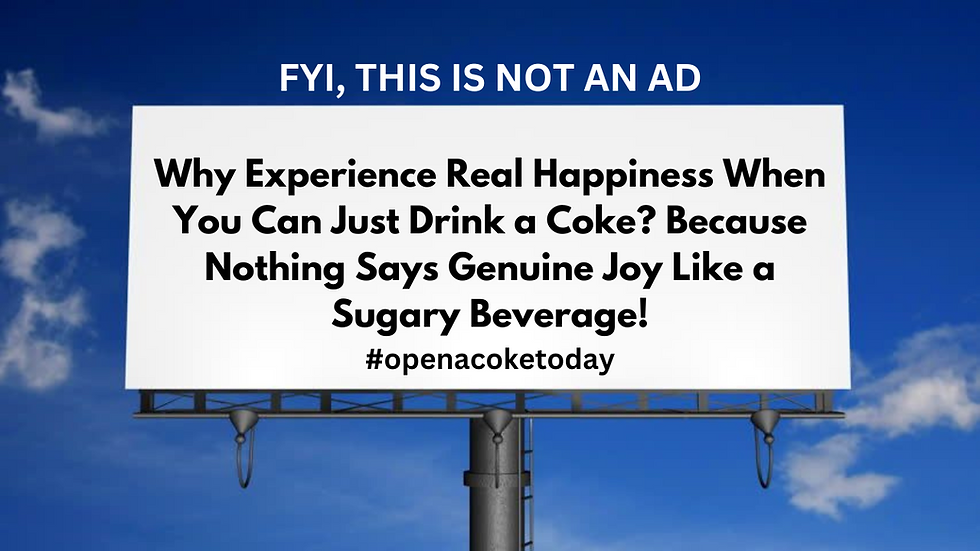
Why Spend Billions on Marketing When You Can Just Be Like Tesla?...
Ah, Coca-Cola, the epitome of marketing genius—because what better way to sell sugar water than by plastering your name on every conceivable surface and spending billions to remind people that you exist?
Meanwhile, Tesla sits back, lets a few tweets from Elon Musk do the talking, and somehow manages to outshine Coke’s entire marketing budget. It’s almost like... spending billions might not be the most efficient strategy.
Who knew?
It's kinda ironic...
The funny part is that Steve Jobs used the exact term 'Sugar water' to poach PepsiCo's most successful CEO John Sculley back then.
Ok! now let me show you the big difference between the marketing of this two Industry giants and how ridiculously ironic they are.
1. The Power of Simplicity

Coca-Cola: “Let’s spend $4 billion a year to make sure every man, woman, and child on this planet knows we’re the go-to for sugary refreshment.”
Tesla: “Let’s let Elon Musk tweet something controversial or inspirational. That should do it.”
It’s almost like people prefer genuine engagement over constant, in-your-face advertising.
Remember when Elon Musk tweeted, “Tesla stock price is too high imo” and the market actually reacted?
That’s the power of influence. Coca-Cola can throw money at Super Bowl ads, but it still can’t buy the kind of attention a single Musk tweet commands.
2. Creating Hype with Minimal Effort
Coca-Cola’s strategy involves endless commercials, sponsorships, and partnerships. It’s the marketing equivalent of shouting from the rooftops. Tesla’s strategy? Whisper a few words and watch the world go wild.
Tesla announced the Cybertruck with a single, memorable event featuring the infamous shatterproof windows mishap. The internet exploded, memes were made, and pre-orders flooded in—all without a traditional ad campaign.
Meanwhile, Coca-Cola probably spent more on a single 30-second Super Bowl spot than Tesla did on the entire Cybertruck reveal.
3. Authenticity Over Saturation
Coca-Cola tries to buy authenticity with campaigns about happiness and togetherness. It’s sweet, but also a bit forced. Tesla, on the other hand, lets its product and CEO’s antics do the talking. It’s raw, unfiltered, and people love it.
The Coca-Cola “Share a Coke” campaign was a hit, but it also reeked of trying too hard to be relatable. Tesla, however, generates organic buzz—whether it’s Musk’s ambitious promises or a new product launch, the excitement feels real and unmanufactured.
4. Word of Mouth in the Digital Age
Coca-Cola’s billions aim to keep the brand top-of-mind through sheer repetition. Tesla relies on word of mouth, amplified by social media. When was the last time someone excitedly tweeted about buying a Coke? Exactly.
Every Tesla delivery turns into a mini-event, with proud new owners sharing photos and reviews across social media.
This organic, peer-to-peer promotion is something Coca-Cola’s traditional ad-heavy approach can’t replicate, no matter how many billions they spend.
5. Innovation Speaks Louder Than Ads
Coca-Cola’s marketing is about maintaining the status quo—reminding you that their product is still here, still the same. Tesla’s approach is about innovation and disruption, which naturally garners attention.
Coca-Cola’s latest marketing innovation? Personalized bottles. Tesla’s latest? Full Self-Driving Beta, revolutionizing how we think about transportation.
One is a cute gimmick, the other is groundbreaking. Guess which one captures more headlines and public imagination?
So, why should businesses rethink their marketing strategies? Because splashing billions on ads to keep reminding people of your existence is the old way.
Why shout when a whisper can do the trick?...
In today’s world, where authenticity, innovation, and real engagement matter more, sometimes less is more. Coca-Cola’s approach might keep them in the game, but Tesla’s minimalistic yet impactful strategy is redefining how we think about marketing.
Let me hear your thoughts on this one.
Do you support Coca-Cola's outlandish and extravagant marketing or Tesla's one tweet poop bomb marketing?


Comments